
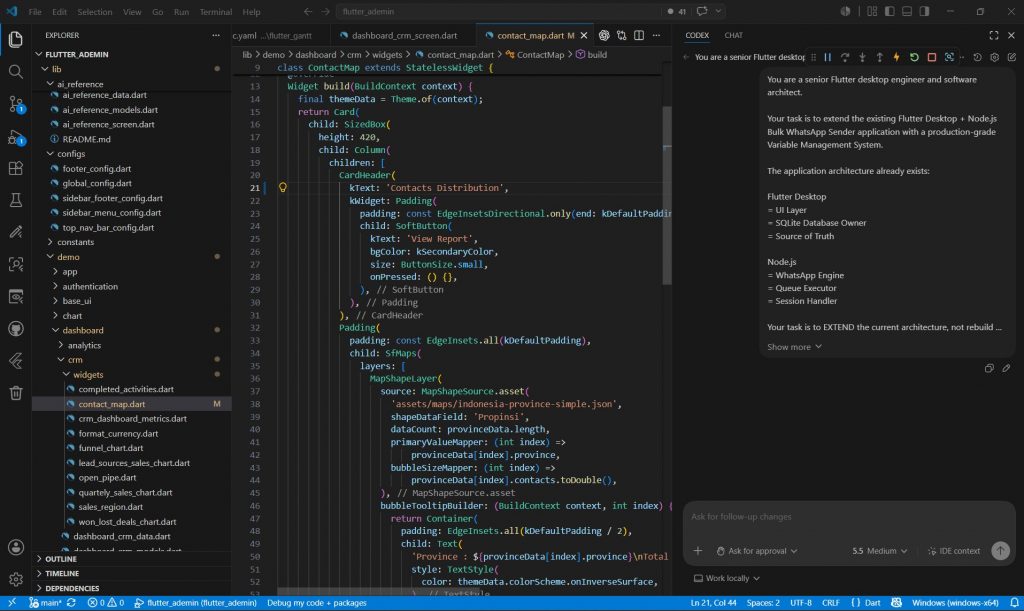
Artificial Intelligence is changing how software is built.
Just a few years ago, AI coding assistants were mainly used for autocomplete and code suggestions. Today, developers are increasingly relying on AI agents that can generate screens, refactor architecture, create tests, write documentation, and even implement complete features.
As agentic development becomes mainstream, the choice of framework matters more than ever.
And this is where Flutter gains a unique advantage.
The Original Promise of Flutter
Flutter was originally designed around a simple idea:
Build once. Deploy everywhere.
With a single Dart codebase, developers can target Android, iOS, Web, Windows, macOS, and Linux.
For many teams, this already delivers significant benefits:
- Faster time-to-market
- Smaller development teams
- Consistent user experiences
- Lower maintenance costs
- Shared business logic and UI
Google reports that many production Flutter applications achieve code-sharing rates above 90% across platforms. This dramatically reduces duplication and keeps products aligned across ecosystems. (flutter.dev)
But in the AI era, Flutter’s value proposition extends far beyond code sharing.
Why AI Agents Prefer Unified Codebases
Modern AI models perform best when working within a single, consistent context.
When a project is split across:
- Swift
- Kotlin
- JavaScript
- TypeScript
- Multiple platform-specific UI frameworks
AI agents must constantly translate business requirements between different languages and architectures.
This creates several challenges:
- Increased token consumption
- More opportunities for hallucinations
- Feature drift between platforms
- Higher review and validation effort
Flutter eliminates much of this complexity.
Instead of generating the same feature three times for three different platforms, AI only needs to generate it once in Dart. The result can immediately be deployed across mobile, web, and desktop. (daily.dev)
For agentic workflows, this is a substantial productivity multiplier.
Less Context, Better AI Output
One of the hidden costs of AI-assisted development is context size.
Every additional repository, language, and architectural pattern increases the amount of information an AI must process before generating useful code.
Flutter reduces this burden through:
- A single programming language (Dart)
- A declarative widget system
- Consistent project structures
- Unified state management patterns
This means AI agents spend less time understanding the project and more time building features.
The result is often:
- Faster generation
- Better consistency
- Fewer corrections
- More predictable outputs
Developers using agent orchestration workflows have reported that Flutter projects tend to be easier for AI systems to reason about compared to fragmented native stacks. (Reddit)
Flutter’s Widget Tree Matches How LLMs Think
Large Language Models excel at generating structured hierarchies.
Flutter’s UI architecture is essentially a tree of widgets.
For AI systems, this structure is naturally predictable:
Scaffold
 ├─ AppBar
 ├─ Column
 │   ├─ Card
 │   ├─ Card
 │   └─ Card
└─ FloatingActionButtonThis declarative approach makes it easier for AI to:
- Generate layouts
- Refactor components
- Extract reusable widgets
- Maintain design consistency
Compared to many platform-specific UI frameworks, Flutter provides a cleaner target for AI code generation. (daily.dev)
Strong Typing Enables Self-Correcting Agents
Agentic development is not just about generating code.
The real breakthrough comes from feedback loops.
Flutter benefits from Dart’s strong type system, which helps AI agents quickly identify and correct mistakes during implementation. Errors surface earlier, making autonomous iteration more reliable. (daily.dev)
Combined with:
- Static analysis
- Hot reload
- Automated testing
- Modern IDE tooling
AI agents can enter rapid generate → validate → fix cycles.
This creates a development environment where autonomous coding becomes significantly more practical.
Where FlutKit Fits Into Agentic Development
The next challenge is not generating code.
It is generating high-quality code.
AI can create screens quickly, but many generated UIs still suffer from:
- Inconsistent design systems
- Poor responsiveness
- Weak UX patterns
- Repetitive layouts
- Technical debt
This is where FlutKit becomes valuable.
Instead of asking AI to create an entire dashboard from scratch, developers can start with production-ready Flutter templates and let AI customize them.
A more effective workflow looks like this:
Traditional AI Workflow
Prompt
    ↓
Generate Dashboard
    ↓
Fix Layout Issues
    ↓
Fix Responsiveness
    ↓
Refactor Code
    ↓
RepeatFlutKit + AI Workflow
FlutKit Template
    ↓
Prompt AI Agent
    ↓
Modify Existing Screens
    ↓
Connect Business Logic
    ↓
Ship FasterIn practice, AI often performs better when modifying existing, well-structured Flutter screens than when generating entire applications from scratch.
This aligns perfectly with the emerging concept of Agent-Assisted Development, where developers provide strong foundations and AI accelerates implementation.
The Future: AI Builds Features, Flutter Provides Consistency
The biggest risk in agentic development is not generating code.
It is maintaining consistency as products grow.
Flutter’s single-codebase architecture helps teams avoid:
- Platform divergence
- Duplicate implementations
- Design inconsistencies
- Maintenance overhead
As AI agents become more capable, frameworks that maximize consistency will gain increasing advantages.
Flutter was originally designed to help humans build for multiple platforms efficiently.
In 2026 and beyond, it may prove even more valuable because it helps AI do the same thing.
And when combined with production-ready UI foundations like FlutKit Dashboard Templates, teams can move from idea to deployment faster than ever—while maintaining the quality standards expected in modern software products.
Conclusion
Agentic development is changing software engineering, but it doesn’t eliminate the need for strong foundations.
Flutter’s unified architecture, declarative UI model, strong typing, and multiplatform reach make it uniquely suited for AI-assisted workflows. Meanwhile, tools like FlutKit provide the production-ready UI layer that allows AI agents to focus on customization rather than reinvention.
The result is a development stack optimized not only for human productivity—but increasingly for AI productivity as well.